Showing posts with label Blackwood. Show all posts

Saturday, 25 November 2017

Harriett Wombwell and Charles John Robinson in Numbers

Harriett Wombwell and Charles John Robinson had nine children. This resulted in – and here is an insight into the times – an astonishing fifty-five grandchildren. Harriett lived long enough to witness the birth of twenty-seven of them. Harriett therefore has to qualify as a grand matriarch of the first order. Even Queen Victoria only managed forty-two grandchildren.

Of course in the world that Harriett and Charles were born into, large families were the norm. Infant mortality was high, and life expectancy as a whole therefore lower. But even in those times, a little bit of wealth, coming in this case through Irish land rentals, enabled a better standard of living. The majority of the children survived, and once they had passed the age of five, the chances of them then reaching a healthy old age were dramatically increased, one of the major remaining risks being death during or after childbirth. On the evidence of these Robinson lines, any kind of birth control practice in the extended family was either only sporadically observed, or sporadically successful. The family spread far and wide and at an impressive rate.


Ratcliffe Highway, St George in the East, the parish where Harriett Wombwell was born. Note Jamrach’s animal shop across the road. From: https://www.flickr.com/photos/100027183@N07/9805332785

There must though have been an economic price to pay for this fecundity and new found longevity. Even when the Irish lands of Maria West had finally been auctioned off in 1881, Harriett’s legacy was a very divided one, even for her children. With the large families that these children then had, it cannot have taken very long for their inherited wealth to vanish. They were then left to make their own way through life using their own wits. Most – but not all – sought to find their way out of the London docks, and all that dockland life represented. Some of the children put the technical skills they had learned in the area into practice, through carpentry, engineering, and through engaging with emergent technologies such as bicycle manufacturing, radio equipment, and nautical instruments. Others fell back into more working class pursuits becoming plumbers, boiler repairers, and the like. There were branches too who were attracted to possibilities overseas, and who made their way to new lives and new possibilities in the dominions.

What all of them seemed to have in common, by and large, was the view that life in the London Docks was less a romantic idyll than an evil necessity. As soon as the opportunity came to move on, they did so. London, the great seducer, which had drawn into her web, Essex farmers like the Wombwells, and Irish emigres like Maria West, and brought them into contact with stalwarts of the maritime community, such as the Robinsons, was beginning to lose its allure. Many of the later Robinson descendants left London entirely and moved on, to the South Coast of England, even then popular as a retirement destination, to Yorkshire, to the West country, and to the New Worlds of Australia and Canada.

In 1805, Horatio Nelson famously pronounced, just prior to the Battle of Trafalgar that ‘England expects that every man will do his duty’. This exhortation however conceals the truth that his fleet and crews were extraordinarily cosmopolitan:

Apart from English, Welsh and Scottish, the Irish were by far the largest contingent with over 3573 men indicating that Ireland was their place of birth. There were over 361 American born sailors. There are examples of Swedes (78), Norwegians (25), Prussians (23), Russians (9), Maltese (25), and Italians (115). From France there were 20, and Spain 8. Even from land-locked Austria there were at least 5. From Canada, particularity Newfoundland and Nova Scotia, 31 men. 17 are listed as born in Africa. They were all probably black although race is not given. Similarly, 123 from the West Indies. Probably all former slaves, now free men and sailors. 


Such was the melting pot of Nelson’s fleet. Whether through desperation, compulsion, patriotism, vocation, or simply a sense of adventure, the assorted multicultural fleet of sailors and mercenaries did Nelson proud. For those Robinsons involved, heralding from Shadwell in the heart of the docks, such diversity can hardly have concerned them too much. Indeed, the Docklands population itself would have very much been a mirror of Nelson’s navy.

This was after all, just a part of what it meant to be part of a global trading empire in which movement of goods was accompanied by - as a natural concomitant - movement of people. This is not to say that these docklanders mixed particularly freely. Race, language, religion, colour, education and social class all played a part in the formation of numerous sub-communities within the whole, with the family being a prime unit of operation.

It is fair to presume that the average nineteenth century mariner would not have been awarded too many prizes for a life of temperance, sobriety and abstinence. The taverns and streets of Shadwell must have fairly hummed with scandal, gossip, and knowing looks. But even in such communities there must have been limits. And when Mary Weston – acting perhaps on the presumption that Charles John Robinson was dead, managed to acquire herself ‘three dark children’ in the space of five years, she must have crossed several lines. Blackwood, well over a century later, recording this in the Linen Hall Library would have raised his eyebrows and given a quizzical shake of his head whilst recording the details. For Mary, he wrote very simply ‘public performer?’, his question mark hanging heavily in the air.

In the end though, it is thanks to the amorous but adventurous Mary – with considerable assistance of course from Napoleon - that Charles John went on to meet Harriett Wombwell – and the rest as they say is history – Robinson history, to be precise.

Thursday, 26 October 2017

The Slave Trade Bites Back?

The next adventure of Charles Robinson has already been mentioned earlier in this tale, and comes, as we know, in two different versions. The first, as reported to the London courts in 1865, was that on his return from France, Charles could find no trace of his wife, Mary Weston, and from then on presumed her dead, a presumption that the presiding judge apparently found rather reasonable.

The second version - from Blackwood, reports that Charles found that Mary in his absence had acquired ‘three dark children’, - ‘whereupon he left her, and never more heard of her’. 

Or to put it another way, he decided that it would be entirely fitting to treat her as if she were dead and to act accordingly. Having endured five years of confinement in France, to then discover that his wife had lost little time in entering a new relationship that broke new boundaries in contemporary attitudes to race, culture and colour – well, let’s just say it can have done nothing for his general temper and mood. Thus it was that the slave trade took a gentle but none too pleasant revenge on Charles, for there must be every chance that Mary Weston had taken up with one of the recently freed slaves from the West India Dock trade. 

Map of Shadwell with Farmer Street at the top right. St. George in the East at the top was the birthplace of Harriett Wombwell. George Wombwell junior’s first marriage took place at the New Gravel Pit Meeting House, Paradise Fields, close to to New Gravel Lane (running parallel to Farmer Street) 


Sunday, 22 October 2017

Captured by Napoleon


Walking through St. Paul's Church, Shadwell, a pathway and steps lead straight down to the Thames. Looking up this smartly-paved jogging route is to look at the exit point from the long since gone Farmer Street from which Charles Robinson would have walked down to the Docks. 
As the nineteenth century commenced, the young Charles John Robinson, seemed to be doing rather well. By the age of twenty, he was already a master mariner. What though does this tell us in the context of the time? 

This is less clear, but putting sources together, Charles had enough knowledge, skills, and character to be entrusted, more or less, with captaining a sea-going vessel of some type. This would have required management skills, meaning delegation, discipline, and punishment, as well as navigational know-how, including use of the nautical instruments of the day and maps. It seems sensible to presume that Charles was literate, capable to a degree, and from a family that was, at least, not at the very lower end of the Farmer Street socio-economic hierarchy.

What happened then? Who was this Mary Weston, this questionable ‘performer’ noted by the disapproving Reginald Blackwood generations later from his desk in Belfast, this woman who Charles chose to marry? Well, at a wild guess, and drawing on what little we know, in the free-mixing, socially and economically diverse Docklands region, for the up-and-coming young master mariner, Charles Robinson, a flirtation with a performing artiste of the locality with a liberal and free persuasion may just have proved too much for him to resist. 

Whatever the explanation however, disaster now struck. In 1809, just shortly after his marriage to Mary, his merchant ship was captured by the French (as seminal as Trafalgar may have seemed, it did not bring the Napoleonic wars to a conclusion). Charles was now to be detained in France at the pleasure of Monsieur Bonarparte until 1814.

Saturday, 21 October 2017

The Birth of Charles John Robinson

Charles John Robinson was born in Farmer Street, Shadwell in 1790. His father, also Charles, was a mariner, and his mother was called Mary, possibly Mary Powell. Charles John followed in his father’s footsteps and became a mariner as well - in the merchant service. In 1809, he married Mary Weston, who according to Reginald Blackwood, continuing diligently to trace the West family from his desk at the Linen Hall Library in Belfast, was a ‘public performer’. 


August 31, 1790 baptism record for Charles John Robinson from St. Paul, Shadwell, the mariners’ church.

St Paul’s, Shadwell is marked by an arrow, as is Shakespeare’s Walk to the left. Farmer Street runs parallel. To the very far left of the map is Betts Street, where Charles Jamrach ran his menagerie business. Harriett Wombwell was baptized at St. George in the East, just close by.

But, at the same time, as the docks expanded, Shadwell was also the home for the mariners, explorers, shipowners, shipwrights, and all the ancillary businesses of the time, such as Richard Wombwell’s chandlers’ store. It was thus also a centre of Georgian and Victorian endeavour and capitalism, and its ill-repute as a den of vice and iniquity should not lead to the assumption that it was merely a slum quarter inhabited only by the low-life of the time, and that anyone with an address in the area was by definition an impoverished illiterate flailing away for survival along with the bottom-end dregs of the society of the time.  

Keeping this in mind may even perhaps provide some glimmers of insight into not only the origins of Charles Robinson, but also Richard Wombwell, and, even more so, the independent and detached Maria West from Downpatrick, who on the surface, had no business of any desirable nature to be pursued in the docks of East London.

Sunday, 11 June 2017

Both Bigamy and Perjury?

Page from the Law Times Report about the Robinson vs. Neale 1865 court case.
Back in Belfast, in the Linen Hall Library, the indefatigable Reginald Blackwood was curious enough about the descendants of the Hadzors and Wests to follow up the lines not just of the Dills but also Maria West and Richard Wombwell. Oddly enough, he turned up a slightly different story about the first marriage of Charles Robinson. The story presented in the court of Judge Malins suggested that Charles Robinson could find no trace of his first wife, Mary Weston, after his return from imprisonment in France and thereafter acted on the presumption of her death. However in Blackwood's notes, he records that when Charles Robinson returned from France, he discovered that Mary Weston, his first wife, had become the mother of ‘three dark children’, at which point he left her and ‘never heard from her again.’ 

This really is not quite the way the story was presented in Judge Malin's courtroom. If Blackwood is correct however, it would appear that not only was there a legitimate case for bigamy, but a further charge that might have been levelled for perjury. 


Harriett Wombwell and her husband had taken no chances though, and undergone a 'second' marriage ceremony in 1864, some forty years after their first. 


Since all of these events must have been conducted in the public eye, so to speak, it does make one wonder what kind of impact and trauma was visited on the wider families of all concerned, given the values of the society of the day.


Monday, 29 May 2017

Hessie Foster Dill and William Archer Kennedy

Hessie Foster Dill was born in 1850. She was the fifth great-grandchild of Susanna West, and the last of those great-grandchildren to be born in Susanna's lifetime. She died in 1931. 

She married William Archer Kennedy on 7th September, 1871. 

According to The Dictionary of Ulster Biography, William was a factory manager in the linen industry, and the family lived on the Upper Shankhill Road in Belfast. Just after the birth of the youngest of their fifth children, William took the family to Poland to take up a post as manager of a linen factory. Hessie died of scarlet fever just months after they relocated and William sent whichever children were with them back to Ireland, to 3 Fisherwick Place in Belfast, there to live with their grandparents, Robert Foster Dill and Catherine Haughton Rentoul.


The original Linen Hall Library in 1888, shortly before its demolition
and replacement with Belfast City Hall.
From:https://en.wikipedia.org/wiki/Linen_Hall_Library
It should be borne in mind that by the time the First World War broke out, Belfast was the biggest producer of linen in the world.

The Linen Hall library where Thomas Russell worked, and later Reginald Blackwood laboriously compiled family trees of the Hadzors, Wests, and so many others, owes its name to the association of Belfast with linen.

Saturday, 6 May 2017

The Disappearance of the Potters

John Potter of 'The Hill' died finally on the 15th April, 1802, aged eighty-five, passing on his estates to his daughters, including Rose Nevin and Elizabeth Carson, later to pass at least some of her lands to her first cousin, Maria West.

Blackwood also notes that in his will, John also left legacies to John Johnston Potter, and David Johnston Potter. Blackwood clearly could not uncover exactly how John Johnston or David Johnston were related to John, and opened a new page for this branch. 


Copied from a Liverpool Irish website. The unique Liverpool identity,
and accent derive from Ireland, rather than England.
The slogan in the photo was coined at the time of the
1916 Easter Rebellion.
It is interesting to observe that like Godfrey West, these two Potters also left County Down for good, and made their way to Liverpool, there to make fresh starts in life. For whatever reason, all was not well for them in Downpatrick. 

Blackwood records six children for John Johnston Potter. Two of these children were apparently tinsmiths in Liverpool and Tranmere respectively. Of David Johnston Potter's four children, two became mariners.

It is said that probably three-quarters of Liverpool's population has Irish descent, with two major periods of influx taking place during the period of the great famine of the 1840s, and, earlier, at the time of the 1798 United Irish rebellion. And certainly it was around this time that both these two Potters along with Godfrey West arrived in the city.

There are a number of other Potters listed on the County Down website of Ros Davies, some no doubt relatives of John Potter, but again there are no clear-cut connections.

As we have learned though, the John Potter who married Maria Hadzor was a highly successful entrepreneur, and the man who was responsible for Harriett Wombwell inheriting her portfolio of County Down lands. The majority of his holdings and wealth passed to his daughters after his death. Whatever legacies he passed on to John Johnston and David Johnston Potter seem to have gone little way to securing for them the life of luxury that John and Maria must have enjoyed in Downpatrick.


Friday, 5 May 2017

The Children of Godfrey West and Elizabeth Hadzor

To recap: Godfrey West married Elizabeth Hadzor, the daughter of Dr. Seneca Hadzor on July 3rd 1759 in Downpatrick Church of Ireland, according to Family Search, and on July 3rd 1760, according to Blackwood. 

Note also that the Family Search Site records the birth of a West child in Downpatrick in 1734, to Thomas West and Mary, interesting given the appearance of a Thomas West in the Downpatrick Freemason records along with Godfrey.

In any case, the four children of Godfrey West and Elizabeth Hadzor were:

i. Susanna (or Juana) West. She was baptized on the 4 July, 1761, and died 23rd February 1851, at ‘The Hill’, Downpatrick. She married William Casement.

ii. Catherine West was baptized on the 14th January, 1763 in Downpatrick. The Belfast Commercial Chronicle recorded her death in 1847. There is a reference to her as one of the owners of the Irish lands in the 1881 auction documentation. She does not appear to have ever married.

  Supplied by Chris West

iii. Maria West was baptized on the 13th February, 1765 in Downpatrick, and died in Stoke Newington, London on the 23rd January 1846. She married Richard Wombwell in St. Pancras, London on the 23rd March, 1802.

iv. John West was baptized in Downpatrick on the 16 October, 1767 and died young, according to Blackwood's notes.

Harriett Wombwell, the daughter of Maria West was to name one of her children - Catherine West Robinson - after one of her Irish aunts. 

Since John West died young, that just leaves us with Susanna (Juana) and Maria. 

Susanna lived to the ripe old age of ninety-one, according to Blackwood, and died in Downpatrick in 1851, the last of the Wests of Downpatrick in our Hadzor-West line. 


The Southwell School on Cathedral Hill, Downpatrick, very close to Downpatrick Prison.
 Susanna West lived somewhere close by.
As detailed by Blackwood however, and through the Peerage Website and elsewhere, there is a wealth of information about Susanna's - or Juana's descendants, to whom we will shortly turn our attention, before returning to the youngest of the sisters, Maria West. 

Saturday, 29 April 2017

The Wests of Clogher

There are no definitive links that show how Godfrey West is related to the main branch of Richard West. Blackwood calls him Godfrey West of Clogher, and we can assume from the age of his wife, Elizabeth Hadzor, that he was born in Clogher some time around 1730. There are records of a number of other Wests in Clogher at this time that may provide some clues however. They include:


  • Richard West (1703-1788), who married Elizabeth. He is of an age to be Godfrey's father.
  • John West (1745-1822), who married Margaret (died 1833). He is of an age to be a younger brother of Godfrey.
Also extant is the 1726 will of another John West of Clogher, which begins:

Sept 9, 1726 John West of Clogher, Parish of downe, County Down, first did appoint his brother Gadson should be paid forty-one pounds, ten shillings out of a bond of forty-three pounds, eight shillings and sixpence due him by his mother Hanah and brother Francis West, and the remainder of said bond he devises to his sister (Mary) Teale, he further devises to his brother Richard West the half of his house and tenement in Killough forever. 

The Richard West referred to in the will could conceivably be the same Richard West noted by Blackwood, and Godfrey's father. Equally, his father could be the John West, whose will it is, particularly when we recall that Godfrey was to name his first and only son, John.

The details in the will, given the reference to lands in Killough, may link up with the history of the West family of Ballydugan originally published by Edward Parkinson in 1906, where he states that in a: 

lease dated 12 January, 1709, Michael Ward of Castleward leased certain messuages, tenements, a garden, and two acres of land, situated in the town of Killough, to James West of Ballydergan, for the lives of the said James West and his sons, Richard and Francis. 


Killough Harbour - the original harbour was built by the Wards of
Castle Ward, Strangford. Photo from Wikipedia.
Parkinson considers it most likely that this James West was a son or grandson of the original Captain Richard West. A grandson, surely, given the time-spans involved.

The John West who married Margaret does have recorded children however, including Richard West (died 1872) The Reverend James Maxwell West (died 1883), Elizabeth West (died 1871) and Mary West (died 1875). Of these children, James Maxwell West married Annie Norman of Lisburn. Parkinson however refers to James as the Reverend Samuel Maxwell West, confirms the 1883 date of death and further tells us that Samuel was the last West of Clogher (or Clougher). He also mentions that the Thomas West who died in 1900 was the last male West of Quoile.

Putting all this together, this is about the best guess we can make:

1) Captain Richard West had a grandson, James West.
2) James West had a number of children, including, possibly, Gadson, Richard, Francis, John and Mary. He may have been married to Hanah.
3) Godfrey West was a child of one of those brothers, most likely, John.
4) Godfrey was therefore a x2 great-grandson of the original Captain Richard West, who was granted lands in County Down by Thomas Lord Cromwell. 


Friday, 28 April 2017

Godfrey West of Clogher

When, some hundred years after the 1641 rebellion, Dr. Seneca Hadzor married off his daughter Elizabeth Hadzor to a seemingly relatively minor member of the West family, he no doubt hoped that the marriage would nonetheless provide a secure future for his daughter.  

But just as the Hadzors were struggling to maintain their own presence and prestige, the West family must also have struggled to cope with the consequences its own rapid expansion. Laws of primogeniture would tend to dictate that unless a rich family was continually able to generate wealth and find suitable marital alliances then children at the lower end of the family lines would start to fall back down the social scale.  This most likely is what had happened to Godfrey West, and in his marriage to Elizabeth Hadzor, it is hard to avoid the feeling that here we have two families trying to make the best of a diminished lineage in the hope that enough remained for them to work their way back up in the world.
Blackwood's notes about Godfrey West and Elizabeth Hadzor. He records that Godfrey lived near the Shambles (Irish Street) and was a failed tallow chandler, who left his family and emigrated to Liverpool after the failure of his business.

Thus it was on the 3rd July 1760 in Downpatrick Parish Church that Godfrey West of the 'new' English colonials married Elizabeth Hadzor (1731-1816), daughter of Dr. Seneca Hadzor, of the 'old' Anglo-Normans. 

Godfrey and Elizabeth were to have four children, amongst them, Maria West, the mother of Harriett Wombwell, and x2 great-grandmother of Hetty Jane Owen.


Sunday, 16 April 2017

The Hanging of Thomas Russell

The Execution of Thomas Russell. From:
http://www.historyireland.com/18th-19th-century-history/thomas-russell-united-irishman/


To say that the United Irishmen rebellion of 1798 was a failure is something of an understatement. One of its leading lights however, and an extraordinary figure and idealist in his own right was Thomas Russell, oddly enough a predecessor of Reginald Blackwood as Linen Hall Librarian in Belfast. Russell's dream of a United Ireland, free of English interference and sectarian division, and founded on principles that owed their origin to The French Revolution and Thomas Paine was not one however that was shared by the English establishment and Protestant Ascendancy.

In 1803 he was tried for his part in the rebellion, found guilty, and sentenced to death. He was moved to Downpatrick prison, and on the 21st October, brought outside the gates and publicly hanged and beheaded. 

Surveying his jury in 1803, Russell is said to have remarked that at least six of them had in the past lent their support to the very cause that he was about to die for. 

Sitting in that very jury listening - not necessarily altogether comfortably - was one Thomas Potter. Another jury member was Arthur Crawford, very possibly a relative of the James Crawford who was a partner in the Ballydugan Mill project. 

Who knows whether any of these Potters, Nevins, Carsons or Crawfords were on Downpatrick Hill that day to see Russell's gruesome end? They certainly had the opportunity should they have wished to witness the spectacle however.

Whatever their inner feelings though, they must have all recognised that the days of Whig Club debates were over. In 1801 the English had passed the Act of Union and abolished the Dublin Parliament, thus creating The United Kingdom of Great Britain and Ireland. The Anglican Church was to be the official church of Ireland, and Catholics were not be allowed to hold public office. The Prime-Minister, William Pitt apparently intended to follow up the Act of Union with some form of Catholic emancipation, but had to resign when George III refused utterly to countenance any such concessions.

Russell spent his last days studying the Book of Revelations, and indeed asked for a stay of execution so that he could complete his commentary. With a macabre touch of gallows humour, the judge turned the request down. The time required to reach a complete understanding of the Book of Revelations, he remarked, would mean that Russell would most certainly end up living longer than most of those present in the courtroom. 

So when Elizabeth Carson wrote her final will in 1833 and made her bequest to the poor of Downpatrick to be distributed without regard to religious distinction, she may just have been thinking back to the days of the United Irishmen and their vision of a united Ireland undivided by sectarianism. 

Monday, 10 April 2017

Joseph Haughton and Catherine Potter

The second daughter of John Potter was Catherine Potter (1752-1813). She married Joseph Haughton in 1799. 

Of Joseph Haughton, the County Down site of Ros Davies records that he was a sailing master who arrived in Downpatrick in 1778 from the West Indies. According to Blackwood he died on 'The Hill' in 1827 and was buried in Downpatrick Church.

As a sailing master with Caribbean connections, there is naturally a possibility that he too was part of the smuggling consortium with sugar being an obvious possible product. 


Ballydugan Mill today. Copied from:
http://www.top100attractions.com/attractions/item/the-mill-at-ballydugan
John, like his father-in-law, was a member of the Downpatrick Whig Club in 1790, and a member in the partnership along with John Auchinleck, Thomas Nevin, John Potter and James Crawford that built and then operated the Ballydugan Flour Mill.

In 1795, Joseph was listed as one of the executors of the will of John Dun of Downpatrick; the other executors were Thomas Nevin and Alexander Gracey. This was probably an ancestor of the Thomas Gracey named in Harriett Wombwell's will as owing her one thousand pounds.

Catherine Potter died in 1813, aged sixty-one.

Friday, 7 April 2017

George Gordon Carson and Elizabeth Potter

George Gordon Carson was a lawyer, and probably the son of Robert Carson, himself a Downpatrick lawyer, resident in the Downpatrick suburb of Vianstown. 

George married Elizabeth Potter, daughter of John Potter, and granddaughter of Seneca Hadzor in 1785. According to Blackwood, the couple separated around 1794, and George died on the 14th June, 1802, aged 55. 

Elizabeth  lived on, and at some point moved across the Irish Sea to Bristol, England, where she died in 1833. 


Obituary for Elizabeth Carson from the 1833 Gentleman's Magazine, 
and Historical Chronicle, Vol. 103. Available on Google books.
Elizabeth Carson is the next key figure in the saga of the 1881 land auction, and is clearly identified in the auction documentation.

Wednesday, 5 April 2017

Seneca Hadzor Disapproves

Central high pulpit originally built for Thomas Nevin in
the first non-subscribing Presbyterian church in Downpatrick
(Down Museum photograph). See: VelvetHummingBee for
more. One of John Potter's daughters was to marry into the
family of Thomas Nevin.
Blackwood notes that Dr. Seneca Hadzor, despite leaving Maria a legacy of 500 pounds, disapproved of her marriage to John Potter. 

It may be that Dr. Seneca was well aware of John’s unorthodox business practices and felt obliged to make some kind of formal statement of censure on this count, without entirely standing in the way of what must have been a highly lucrative marital catch. 

It may also be that as a descendant of the old Anglo-Norman Catholic establishment, albeit realigned to the Church of Ireland, that he felt uncomfortable about marrying off a daughter into what was probably a Scots Presbyterian family. 

Regardless, the marriage went ahead, and whilst so many of John’s contemporaries made a new life for themselves in America, a land in which their religious beliefs would not present an obstacle to progression, John used the earnings from his smuggling operation to venture into the real estate business. John and Maria's children were to reap handsome benefits, as indeed were the succeeding generations.


Monday, 3 April 2017

John Potter

John Potter in the 1881 auction lot details.
Maria Hadzor, the second daughter of Seneca Hadzor died around 1763 in Downpatrick. She married John Potter and they were to have three daughters. 

Blackwood records that John Potter (1717-1802) spent time in America and that he smuggled brandy and tobacco from France, America and the West Indies earning in the process, £30,000. He also states that he was a linen weaver and bought and sold yarns.

With this not inconsiderable sum of money, John bought up lands in the Lecale, Kilmore and Portaferry districts of County Down. John also seems to have had a Downpatrick grocery business (1747) on Scotch Street, opposite Market House, and to have leased out part of the Upper Ballymote Townland from the Southwell Estate in 1752.

There is a further reference to John Potter in the Vestry Books for the County of Down, as reproduced below:

It is not, however, until the year 1777 that there is any reference to the cleansing and lighting of the streets of Downpatrick. In the years 1759,1765, and 1773 acts were passed by the Irish parliament providing for the lighting and cleansing of cities and market towns, the administration of such acts being, as a rule, vested in the vestries. On 15 Sep., 1777, a meeting of the vestry was held in the parish church of Down, "in order to cleanse the streets and light the town of Downe, pursuant to an act of parliament in that case made and provided." This meeting was adjourned for a week. At the adjourned meeting it was resolved "That William Trotter, Richard Caddell, James Crawford, escjrs., and Mr. John Potter shall be directors, and survey the town in order to range the inhabitants into four classes: that the first class, in order to the cleansing and enlightening the town of Downe, should pay the sum of six shills. and sixpence; the 2nd, four shills. and fourpence : the 3rd, two shills, and twopence; and the fourth according to an applotment made thereof." This meeting was adjourned to 29 Sep., 1777, when it was resolved "that twenty-five lamps shall be hung in the most convenient parts of the town of Downe; that the streets of said tcnvn, where paved, shall be swept twice a week, and where not paved shall be gathered with a shovel…

See: www.jstor.org/stable/20566341

In 1791, John went into partnership to build Ballydugan Flour mill with his son-in-law, Thomas Nevin, along with James Crawford (see excerpt above) and John Auchinleck. John is also listed as a member of the Downpatrick Whig club in 1790.

With these small details, we at least glean some insight into the life of John Potter and his immediate circle, a life in which the politics of the day, religious observance, civic engagement, and a free-flowing entrepreneurial spirit merged into a unique but not always entirely legal set of configurations.  

This is the John Potter who makes an appearance in the 1881 Belfast auction lot details, and it is beyond doubt that the Irish lands of Maria West and Harriett Wombwell were a direct product of John's highly lucrative smuggling enterprise. 

John was buried in a vault at the Downpatrick Meeting House Yard, confirmation that this was a Presbyterian family.


Monday, 27 March 2017

The Hadzors of Downpatrick: A Tree

With the help of Blackwood and other sources, including the extant will of Lieutenant John Hadzor, the Hadzor family tree in Downpatrick looks something like this:


The John Potter who is named in Harriett Wombwell's auction proceedings for 1881, now emerges as a son-in-law of Dr. Seneca Hadzor. Elizabeth Hadzor and Godfrey West, who appear at the bottom of the tree, were Harriett Wombwell's grandparents.

Sunday, 26 March 2017

Linen Hall Library, Belfast, July 2016

The Linen Hall library in Belfast dates from 1788, and houses a
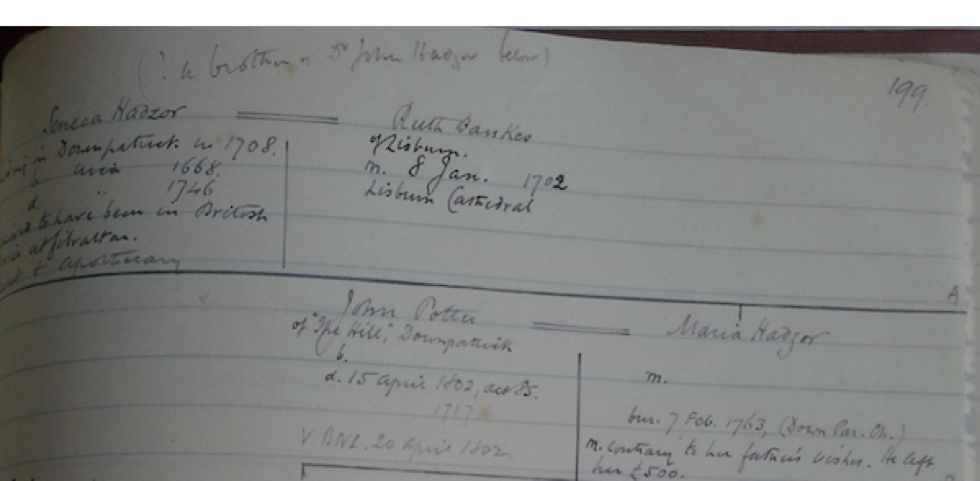
Blackwood's page for Seneca Hadzor.
wealth of historical and archival information about Ireland. One unique collection to be found there is the Blackwood pedigrees, comprising over ninety volumes of handwritten family trees and notes painstakingly put together by Reginald Blackwood (died 1961), a former Director of the Library. 


The records have never been digitilised, and it would seem that the only way to gain access to them is to head to Donegall Square and examine them in person. What then emerges is truly a labour of love and dedication, and it was astonishing to find in one of the volumes, records that follow the Hadzor family of Downpatrick all the way through to Hetty Jane Owen’s grandmother, Maria Harriett Robinson.

A second outstanding resource is Ros Davies’ County Down website, which has collated a wealth of information about County Down. Records on Family Search, the Mormon Salt Lake City genealogy database have provided further detail, and together all these sources and others to be provided in due course have helped put together the tale of the Downpatrick Hadzors and related families.

It was of some comfort, sitting in the calm of Linen Hall Library to find that the problem of the relationship between Dr. Seneca Hadzor and Lieutenant John Hadzor had given Blackwood pause for thought. 

Twenty-seven years separate their respective births, and John was born seven years before Seneca Hadzor’s marriage to Ruth Bankes in 1702. This led Blackwood who had originally put down John as a son of Seneca to append a note, querying whether he might not actually be a brother. If so, the answer would probably be that he was a half-brother, from a previous marriage of Seneca’s father. An alternative of course would be that Blackwood had it right the first time and that Lieutenant John Hadzor was indeed Seneca's son, but from a previous marriage.  

Both Seneca and John were doctors, both served in the British army in Gibraltar, and both lived in Downpatrick. It is quite impossible to suppose that they were not extremely closely related.